4D Gaussian Splatting (4DGS) enables real-time rendering of complex dynamic scenes with high fidelity,
but its trajectory representation remains expensive to store. Recent rate-distortion optimized methods
substantially reduce this cost, yet important dynamic components remain largely uncompressed. In
particular, position wavelet approximation coefficients and rotation keyframes account for over 30% of
the total bitstream. The key challenge is not simply to quantize these trajectory attributes, but to
first put them into a form that can be quantized effectively. In their native form, these signals carry
structure that is benign for representation but detrimental to codebook learning: wavelet approximation
coefficient magnitudes vary by orders of magnitude across Gaussians, from near-static to fast-moving
points, risking severe gradient imbalance during quantization-aware training if not explicitly
conditioned, while absolute rotations and positions retain predictable temporal variation.
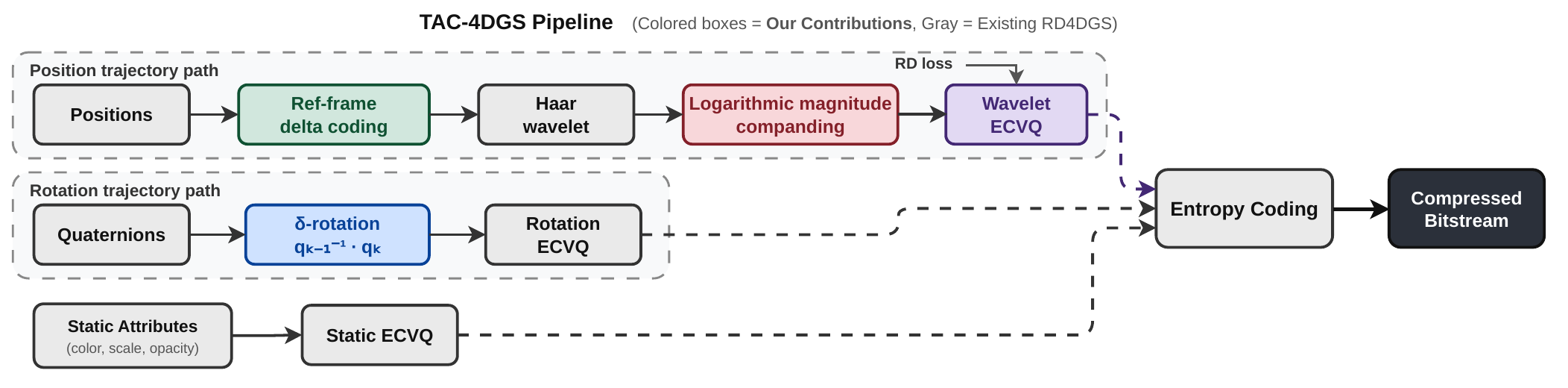
We present TAC-4DGS, a trajectory-aware compression method that reparameterizes these
components before quantization. A data-adaptive logarithmic companding transform balances wavelet
approximation coefficient scales and enables stable end-to-end codebook training, while inter-frame
delta rotation coding and reference-frame position subtraction remove predictable structure before
quantization. TAC-4DGS achieves 41.9% average bitstream reduction on N3V and 33.8% on Technicolor
relative to state-of-the-art 4DGS compression, with PSNR differences of only −0.31 dB and
+0.40 dB respectively. As a coding-level extension requiring no changes to the underlying rendering
pipeline, TAC-4DGS achieves a 93.6–99.1% total size reduction relative to the uncompressed 4DGS
representation.